THE PATTERN, THEN THE PRACTICE · BEGINNER GUIDE
What are moving lines in the I Ching?
Learn how three coins cast six times form a primary hexagram, why only some lines move, and how the relating hexagram adds another perspective.
▶ Watch the 72-second lesson
English narration and captions. Optional Chinese subtitles are available in the player.
A reading begins with a pattern
A hexagram has six lines. Each can be solid (yang) or broken (yin). In YiPhase’s coin method, you cast three virtual coins for each line, six times. The first cast becomes the bottom line; the last becomes the top. Three coins, six throws — not six coins.
The pattern before any changes is your primary hexagram, or 本卦. It offers a starting perspective on the situation you asked about. Your question and circumstances determine how the imagery becomes relevant; the hexagram alone cannot tell us the facts of your life.
What makes a line move?
YiPhase counts each head as 3 and each tail as 2. Add the three coins. The result is 6, 7, 8 or 9. Odd numbers draw a solid line; even numbers draw a broken one. Only 6 and 9 mark a line as moving.
| Total | Primary line | Does it change? |
|---|---|---|
| 6 · old yin | Broken | Yes → solid yang |
| 7 · young yang | Solid | No |
| 8 · young yin | Broken | No |
| 9 · old yang | Solid | Yes → broken yin |
A moving line is a point of transition within the reading. Its position and classical text help focus the interpretation. It is not a diagnosis, an inevitable event, or a line you choose because its message sounds attractive.
How does the relating hexagram form?
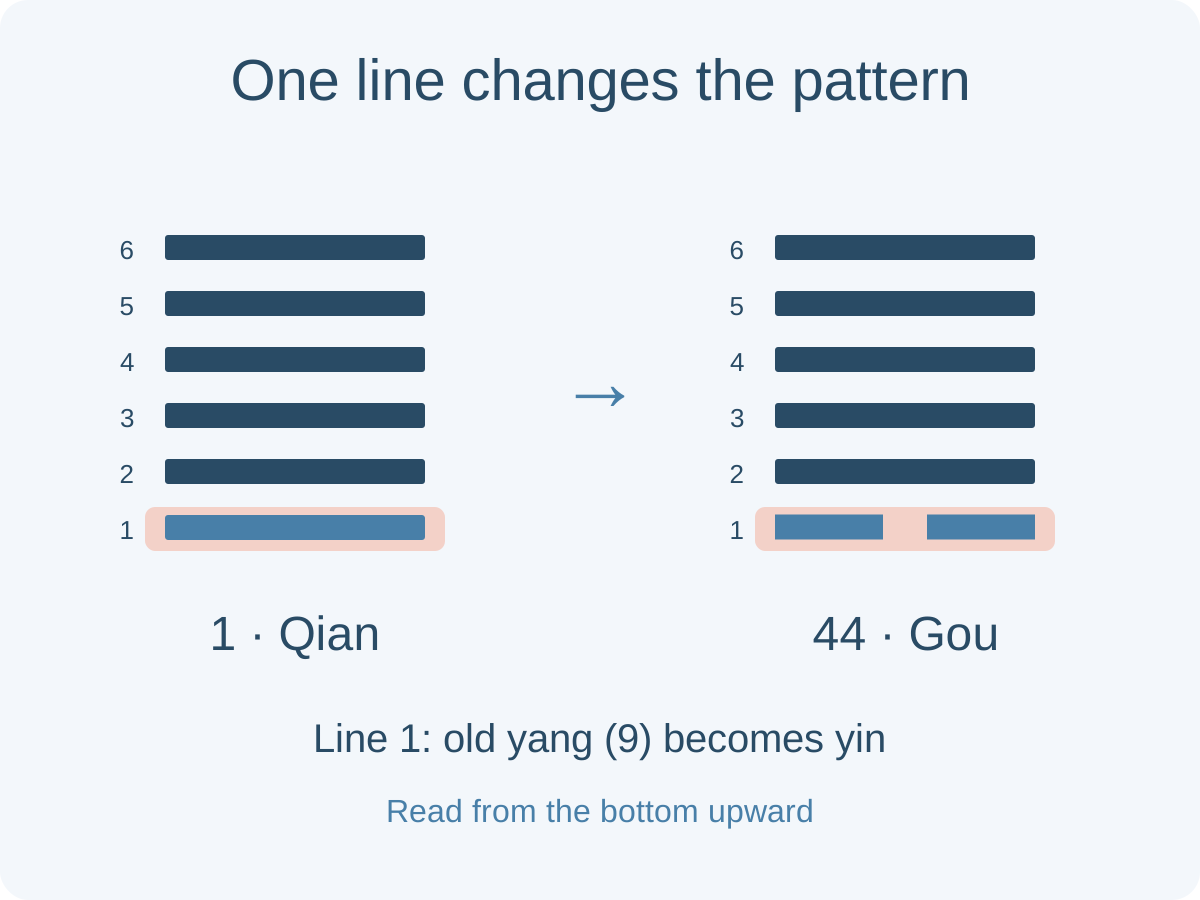
Change every moving line to its opposite, leaving all other lines alone. That new pattern is the relating hexagram, also called the changed hexagram or 之卦. It adds a direction, contrast or condition to explore. It does not guarantee the future.
A concrete example: a new business idea
Suppose you ask: “What should I understand before launching my small business?” In the illustrated example, Qian’s first line is moving. Its text is 潜龙勿用 — the hidden dragon; do not act yet. A practical reading could ask whether you have tested demand, understood costs, and prepared a small first step.
This is different from “you will fail.” It asks whether the timing and foundations fit the action. If the idea is still untested, a small customer interview or prototype may be wiser than a large commitment. If you already have evidence, the interpretation needs that context rather than treating you as an absolute beginner.
The resulting Gou introduces the theme of encountering an influence. One useful follow-up might be: “If a new partner or sudden opportunity appears, what boundaries should I keep?” Gou is not proof that a particular person will arrive. The change gives us a second lens for the same question.
What if several lines move — or none?
With one moving line, its text provides a clear focus. With several, interpretation needs a consistent method for choosing which texts carry the most weight. YiPhase uses a stated, traditional text-selection approach; it does not simply pick whichever line is most flattering.
With no moving lines, the primary pattern remains unchanged. Read its overall situation and action guidance. There is no separate changed pattern to manufacture. You do not need another cast to obtain a more dramatic result.
And the nuclear hexagram?
The nuclear hexagram, or 互卦, is formed from the inner lines of the primary hexagram: lines 2–3–4 make its lower trigram, and lines 3–4–5 make its upper trigram. It can help explore an underlying tension or intermediate process. It is an auxiliary pattern, not another throw, another person’s secret, or a verified fact.
Take these three questions into the reading
- Where is the pressure to change? Look at the actual moving positions.
- What does the line text suggest here? Connect its imagery to known circumstances, rather than translating it mechanically.
- What action can I test? Name one step, one risk, and a time to review what happened.
In Mei Hua Yi Shu, the moving line also helps distinguish the body and use trigrams. Learn that relationship →
Classical texts: Zhou Yi · Qian and Gou. The business example is YiPhase’s original teaching analogy, not a quotation from a modern teacher. Readings support reflection; they do not establish future facts.
中文解说 · Read in Chinese
动爻与变卦:先看图,再看行动
三枚铜钱投六次,自下而上成卦。YiPhase 约定正面计 3、背面计 2,总数为 6、7、8、9。6 是老阴,变为阳;9 是老阳,变为阴;7、8 为静爻。把所有实际动爻反转,其余不变,就得到之卦。
图中为教学示例:乾卦仅初爻动,成为姤卦。初爻“潜龙勿用”可提示创业前先验证需求、成本和准备程度;不是断言失败。如果已经有验证结果,就应结合事实分析。姤的“相遇”则帮助审视新合作或突发机会的边界,不能凭卦断言一定有人出现。
多爻动要按一致的取文规则确定重点,不能挑好听的爻辞。没有动爻时,本卦不变,不需要制造变卦,也不必反复摇。互卦取本卦二三四爻为下互、三四五爻为上互,用来辅助观察内在过程,不代表已查明的隐情。
解读的落点是:哪里可能变化?爻辞如何对应已知情况?下一步能做什么、要防什么、何时复盘?这里的商业案例为 YiPhase 原创教学类比,并非某位教师的原话。