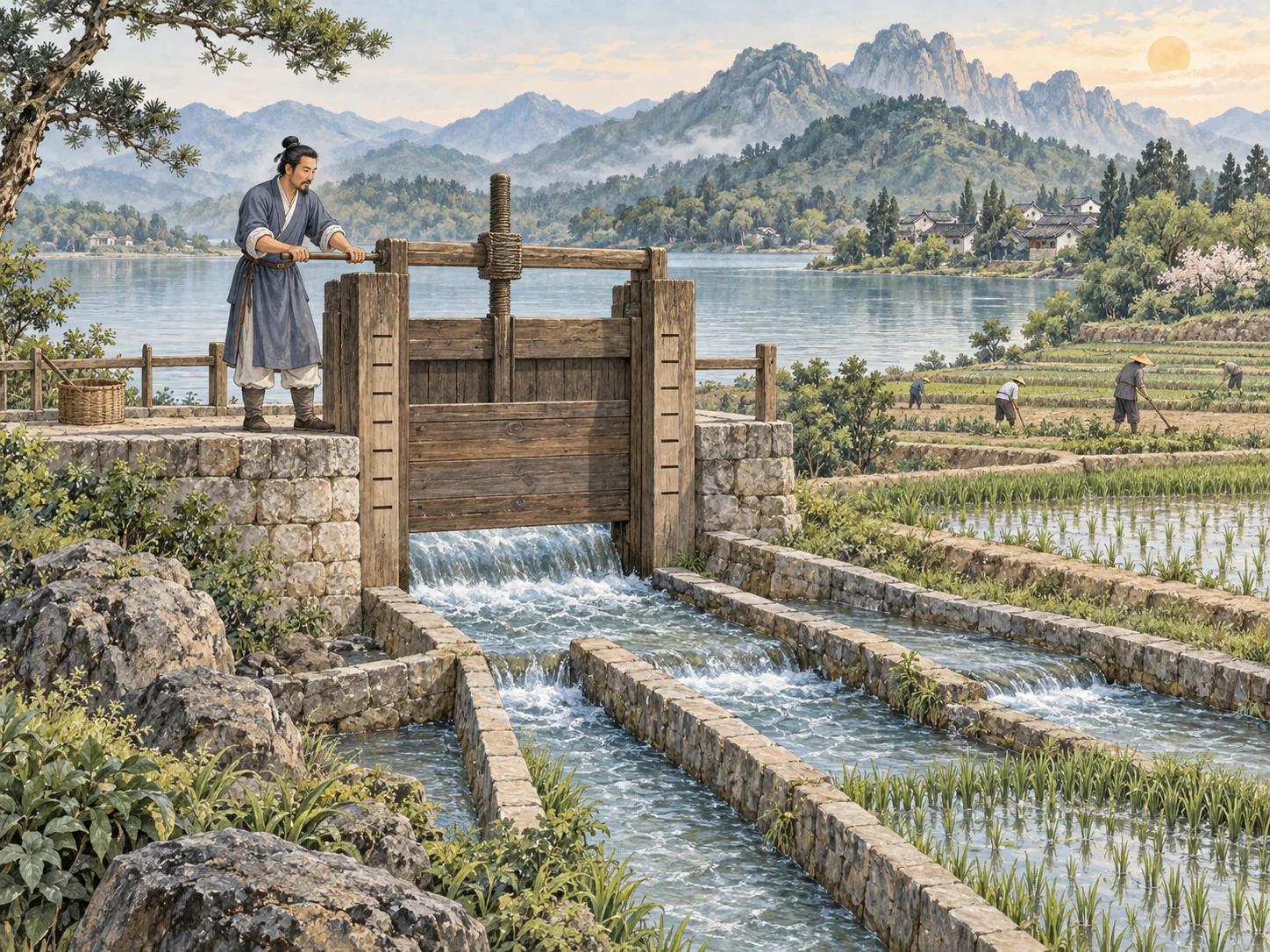
1. Make limits people can live with · 象曰:澤上有水,節;君子以制數度,議德行。
The lake contains water because it has a shore. Jie is a fitting measure: seasons follow their intervals, and human rules should conserve resources without injuring people.
节是使事物有度。湖泽容水,有边界才不会漫溢;《彖传》以四时有序与制度不伤财、不害民说明好的限制必须合乎时宜。
A lake gives water a form rather than imprisoning it. The ancient image speaks of measures and the assessment of conduct.
泽有容量,水有水位。古文中的“数度”是礼制与用度的等级尺度,“议德行”是衡量人的德与行。
A neighborhood tool library is deciding how many items each household may borrow. The coordinator wants tools to circulate freely, yet without any boundary, shared equipment disappears.
社区工具图书馆在讨论每户能借多少件。协调人希望工具自由流通,但毫无边界,共享工具就会消失。
2. Pause to understand the way · 不出戶庭,无咎。
The plan is not ready. Remaining within the inner courtyard protects the work while its openings and obstacles are studied.
《正义》解释为事情初起,先辨明通与塞,慎密而不泄。图中人留在内庭审看尚未成熟的水工方案;此时的“不出”是有目的的准备。
The coordinator keeps the draft rule in the back office, comparing repair logs before posting anything. Nothing leaves the inner room yet.
协调人把草拟规则留在里间办公室,先对照维修记录,看哪些工具最容易损坏、哪一种借还上限真正有用。
The pause is not secrecy for its own sake; it lets her see which tools break most and where a borrowing cap would actually help.
此时不公开,不是为保密而保密,而是给规则留出辨明通塞的准备时间。
3. Know when to open the gate · 不出門庭,凶。
The finished plan is held behind the outer gate while the workers wait. What was wise privacy in line one has become a missed moment.
门庭比初爻的户庭更外一层。《正义》说制度既已制成,这时该宣行,却仍藏匿便误了时机。
The rule is finished, but it still sits inside the front gate. Volunteers and patrons wait at the door with donated drills and saws; the coordinator keeps revising a cover note.
规则已经写好,却仍搁在前门之内。志愿者和居民带着捐来的电钻、锯子等在门外,协调人却一改再改通知稿。
What was wise preparation in line one has become a missed opening. A boundary that never opens can also harm.
初爻的谨慎准备,到这里变成了错过时机。该开而不开的边界,也会造成伤害。
4. Own the cost of excess · 不節若,則嗟若,无咎。
The broken measure and spilled grain make the excess visible; lament follows. The Image's question, 'Whom else could one blame?', keeps responsibility with the actor rather than excusing the loss.
失度导致嗟叹。《象传》反问“又谁咎也”,意思是后果出于自身,不能推给别人;不是说浪费无妨。
With no checkout limit, the tool library lends six saws to one household and leaves no return date. By autumn, several tools are missing and the repair shelf is bare.
没有借还上限时,工具图书馆把六把锯子借给同一户,也没写归还日期。到了秋天,几件工具不见,维修架空了。
The coordinator sits beside a broken storage bin, sighing. The Image asks who else could be blamed; the loss traces back to the missing limit.
协调人坐在裂开的储物箱旁叹息。《象传》问“又谁咎也”,损失正追回到当初没有设限。
5. Make the measure livable · 安節,亨。
The modest sluice lets water reach the fields without burdening the village. When a measure fits its place, people can keep it without strain.
六四得位而顺,安于适当的节度。《正义》强调能安行而不变其节。
Now the library posts a simple limit: three tools per household, two weeks, one renewal. The water steward image fits here—a modest sluice lets water reach the fields without strain.
现在图书馆贴出一条简单规则:每户三件,两周归还,可续借一次。六四“安节”像一道不大的水闸,把水引到田里,不用苦苦支撑。
Patrons adjust without complaint; volunteers keep the shelf steady. The limit succeeds because it sits where daily life can actually hold it.
居民自然适应,志愿者也能让货架保持稳定。能安行的节度,才是通达的规则。
6. Let fairness make restraint acceptable · 甘節,吉;往有尚。
A fair basket gives each household enough while preserving the common store. The limit feels 'sweet' because its burden is proportionate and shared, not because everyone receives abundance without measure.
“甘”与末爻的“苦”相对。《正义》把甘节落实为中正持度、不伤财也不害民。
The coordinator introduces one fair measure: a shared lending cap linked to household size and a repair fund everyone contributes to equally.
协调人推出一把共同量具:借还上限按家庭需要调整,维修基金由大家等额分担。
No one gets abundant tools without limit, but every household gets enough to finish its work. The limit feels sweet because its weight is proportionate and visible. Others begin to respect the rule and copy it.
没有人能无限制地拿很多工具,但每户都够完成手头的活。九五“甘节”不是说样样充裕,而是负担相称、看得见。别人开始尊重并效仿这条规则。
7. Do not make hardship the rule · 苦節,貞凶,悔亡。
The granary is full, yet the ration is painfully small. Classical commentary distinguishes imposing harsh limits on others, which brings harm, from personal frugality, which may remove regret.
节制走到极端就变苦。《正义》区分两层:以苦节强施于人,会使人不能承受而凶;用来约束自己,可因俭约而无悔。
The board, fearing loss, locks a cabinet full of donated tools and sets a painful deposit. A family with a leaking roof is turned away, even though the storeroom is full.
董事会怕丢工具,把满柜捐赠工具锁上,又定下令人难受的押金。一户屋顶漏水的人家被拒之门外,尽管仓库是满的。
The keeper also works without a heater to show austerity, but one person's frugality cannot justify another's deprivation. Harsh limits may remove regret only for the one choosing them.
管理员自己也省着不开暖气,以显清苦;但一个人的俭约,不能替别人的匮乏辩护。苛酷的限制,或许只让设限者自己少些悔意。
8. Does the limit protect life? · 節:亨。苦節不可貞。
A well-set boundary opens a path. Classical commentary insists on a middle measure: severe deprivation is too harsh to sustain.
节制使事情通达,但《正义》说节须得中,过苦会伤于刻薄,使人不能承受。“不可贞”不是全盘反对约束,而是反对把令人受苦的极端约束固定成正道。
The question is when a boundary serves life and when it closes it down.
关键不在限制越多越好,而在知道何时、为何、为谁设限。
Where in your shared life would a clear, kind limit protect the whole without shutting people out?
在你的共同生活中,哪一处需要清楚而善意的边界,既保护整体又不把人拒之门外?