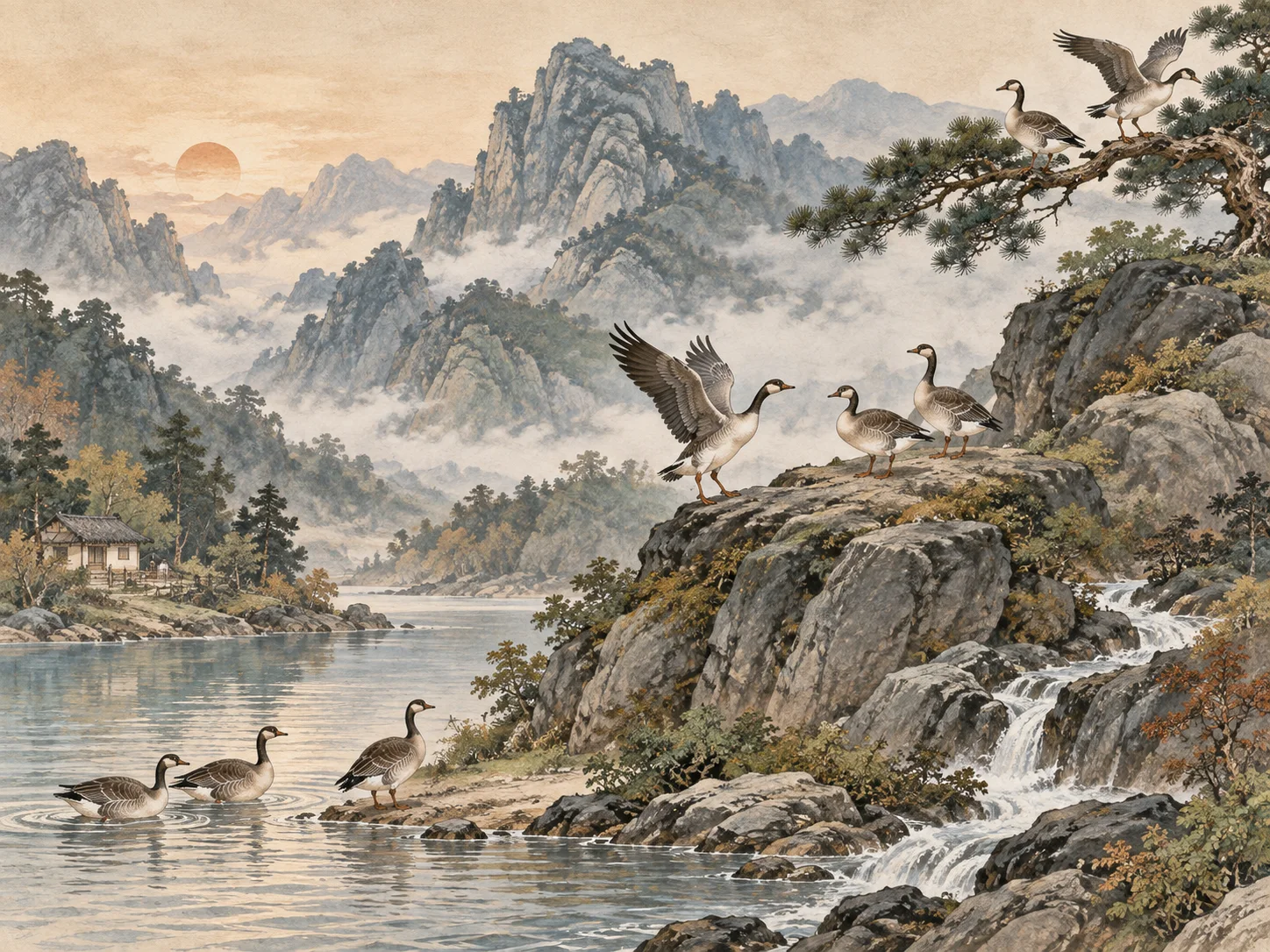
1. Each step needs a place to land · 象曰:山上有木,漸;君子以居賢德,善俗。
A wild goose moves from bank to rock, dry land, tree, hill, and high ground. Gradual Development is not slowness for its own sake: each stage needs a fitting place and a sound relationship to others.
渐不是只求慢,而是循序找到合适的位置。卦辞以古代婚嫁礼序说“女归吉”,《彖传》强调进得其位、进以正;《象传》以山上树木的生长比喻德行与风俗的积累。
A tree on a mountain takes root before it rises. Character and shared habits develop through repeated practice, not a single dramatic leap.
山上的树不是一夜长成。德行与共同生活的习惯,也靠长久安住与日常践行形成。
A young apprentice joins a riverside boatyard to learn a traditional craft. Over six stages, she moves from the muddy bank to a shared workbench, then to an inland contract that pulls her household apart, a high loft where she finds an unexpected beam, a long-delayed reunion, and finally a launching ceremony where her work becomes a pattern others can follow.
一位年轻学徒来到河畔船坊学习传统木船工艺。六个阶段里,她从泥岸边起步,到共享工作台,再到一份让家庭分离的内地合同、高处阁楼里意外可用的横梁、漫长等待后的重逢,最后在下水礼上,她的手艺成为别人可遵循的样式。
2. Test the bank · 鴻漸于干,小子厲,有言,无咎。
The goose has only reached the bank. A child's alarm makes the early risk audible; warning words need not become blame if they help the next step become safer.
“干”是水边岸地。雁刚离水,孩子见险而呼,提醒初进时的不安与议论;谨慎听见警告,不必因起步不稳而自责。
On her first morning at the muddy bank, Lina's young cousin points at the rising tide and shouts a warning. Other workers repeat the caution.
第一天清晨,莉娜在泥泞河岸边,年幼的表弟指着上涨的潮水大声警告,其他工人也跟着提醒。
Lina feels embarrassed but checks the mooring rope anyway. The early alarm prevents a mistake, so no blame falls on the child or on her.
莉娜有点窘,却仍去检查缆绳。早来的提醒避免了一次失误,所以孩子和她都不受责怪。
3. Rest on sound ground · 鴻漸于磐,飲食衎衎,吉。
A broad rock supports the flock. Eating together expresses ease earned by a reliable foothold; this stage allows nourishment before the next move.
磐石宽稳,雁群有了可安食的地方。“衎衎”是和乐,不是得意忘形。
On a broad flat rock by the water, the crew stops for lunch after Lina learns to secure a plank. The older boatbuilder shares rice and tea; jokes pass around.
在水边一块宽大平稳的岩石上,莉娜学会固定木板后,船坊众人停下来吃午饭。老师傅分米饭和茶,笑话在中间传来传去。
The stable stone under them matches the reliable bench behind them. This easy meal is not laziness; it is nourishment earned by a footing that holds.
脚下的磐石像工坊里那张可靠的案子。这顿轻松饭不是得意忘形,而是站稳后得到的休养。
4. Protect what remains · 鴻漸于陸,夫征不復,婦孕不育,凶;利禦寇。
Higher ground is not automatically safer. The departing husband, empty cradle, and guarded gate make separation and loss concrete.
陆地看似更高,却可能离开原本的生存条件。爻辞用征夫不归、妇孕不育写关系断裂及失落,并提出“御寇”——先守护共同体。
Lina's spouse accepts an inland contract and does not return as promised. Her own plan to open a children's sailing class cannot be nourished while she is alone.
莉娜的伴侣接下一份内地合同,却没有按约回来。她想开儿童帆船班的计划,在独自支撑中得不到滋养。
Tools vanish from the yard. Neighbors form a night watch. The higher dry land looked safer, but it broke the household and exposed the yard; guarding the community is the useful response.
工坊工具也开始丢失。邻居们于是组织夜间守望。看似更高的旱地并未更安全,它拆散了家庭,也暴露了船坊;守住共同体才是可行的应对。
5. Find a workable perch · 鴻漸于木,或得其桷,无咎。
A goose is not naturally at home in a tree. A level, rafterlike branch makes an unusual position workable.
鸿雁并不惯栖树,树上若有平直如桷的枝条才可站稳。进入陌生环境时,不必强装适应;先找到真实可用的支点。
Sent up to the loft to sort long masts, Lina feels as out of place as a goose in a tree.
被派到阁楼整理长桅杆,莉娜像落在树上的鸿雁一样不自在。
She spots a straight, rafter-like beam and ties her tools to it. Using that real support instead of pretending comfort, she works safely. No blame comes from an unusual perch that actually holds.
她发现一根平直如椽的横梁,把工具系在上面。她利用这个真实支点,而不是假装适应,因而安全干活。不寻常的位置只要确实能承重,就无可责怪。
6. Endure the long delay · 鴻漸于陵,婦三歲不孕,終莫之勝,吉。
The three years mark a long, painful delay. The line ends with the obstacle no longer prevailing.
“三岁”突出漫长等待;“终莫之胜”是阻隔不能永远压过关系。图用两人与双雁在山陵重逢表达此转折,不把经文转译为现实生育结果的保证。
For three years, Lina and her spouse wait to adopt a child; paperwork and distance keep the hope from bearing. On a grassy hill above the boatyard, they finally meet the social worker.
三年里,莉娜和伴侣等待领养孩子,手续与距离让这份盼望迟迟不能结果。在船坊上方的草坡上,他们终于见到社工。
The obstacle does not prevail forever. Their joy is real, but the line does not promise every long wait will end the same way.
阻隔并非永远得胜。他们的欢喜是真实的,但这一爻并不保证每一段漫长等待都会有同样结局。
7. Leave a worthy pattern · 鴻漸于陸,其羽可用為儀,吉。
At the last stage, even the goose's feathers can serve as a ceremonial pattern. The image points beyond private success: a patient course may leave a form others can honor and learn from.
从起步的岸到最终高陆,雁的羽成为可供仪礼的美好形象。此处的价值不在占有鸟,而在长期进展留下可供他人遵循的风范;图以自然落羽组成仪饰。
At the high upland launching, Lina's boat enters the water. She has saved naturally shed goose feathers from the riverbank and woven them into a simple ceremony ornament.
在高地举行的下水礼上,莉娜造的船入水。她把河岸边自然脱落的雁羽保存下来,编成简朴的仪式饰物。
Her patient course becomes a pattern the apprentices can follow. The good ending is not possession of the bird but a form others can honor and learn.
她这段渐进的历程,成了学徒们可遵循的样式。吉祥不在于占有鸿雁,而在于留下别人能敬重、能学习的形式。
8. Is the next landing ready? · 漸:女歸吉,利貞。
The judgment uses an ancient marriage custom as its image of an orderly transition. It does not prescribe modern gender roles or promise a result.
“女归”是古代女子出嫁的礼制语境,以循序成礼说明进展须合时、合位。这里保留原文,不把古代婚姻分工当成当代人的义务,也不把“吉”理解为不经努力的保证。
The lines include comfort, separation, defense, and eventual reunion; progress is real only when its foundations can bear it.
人事中的分离、生育与守寇属于古代处境,今天可从中读出守护关系、节奏与边界,而不把女性命运归结为一个吉凶符号。
Where in your own gradual journey do you need a firmer footing before the next stage?
在你自己的渐进旅程中,下一步之前,哪里需要更稳的立足点?